US-China Thaw: Global Economy & Australia Investment Opportunities
The International Monetary Fund's (IMF) positive assessment of the dialogue between the leaders of the United States and China has injected a strong boost of confidence into the global economy. This article will delve into the profound impact of the easing US-China relations on global trade, supply chains, and the Australian economy, and explore potential investment opportunities.
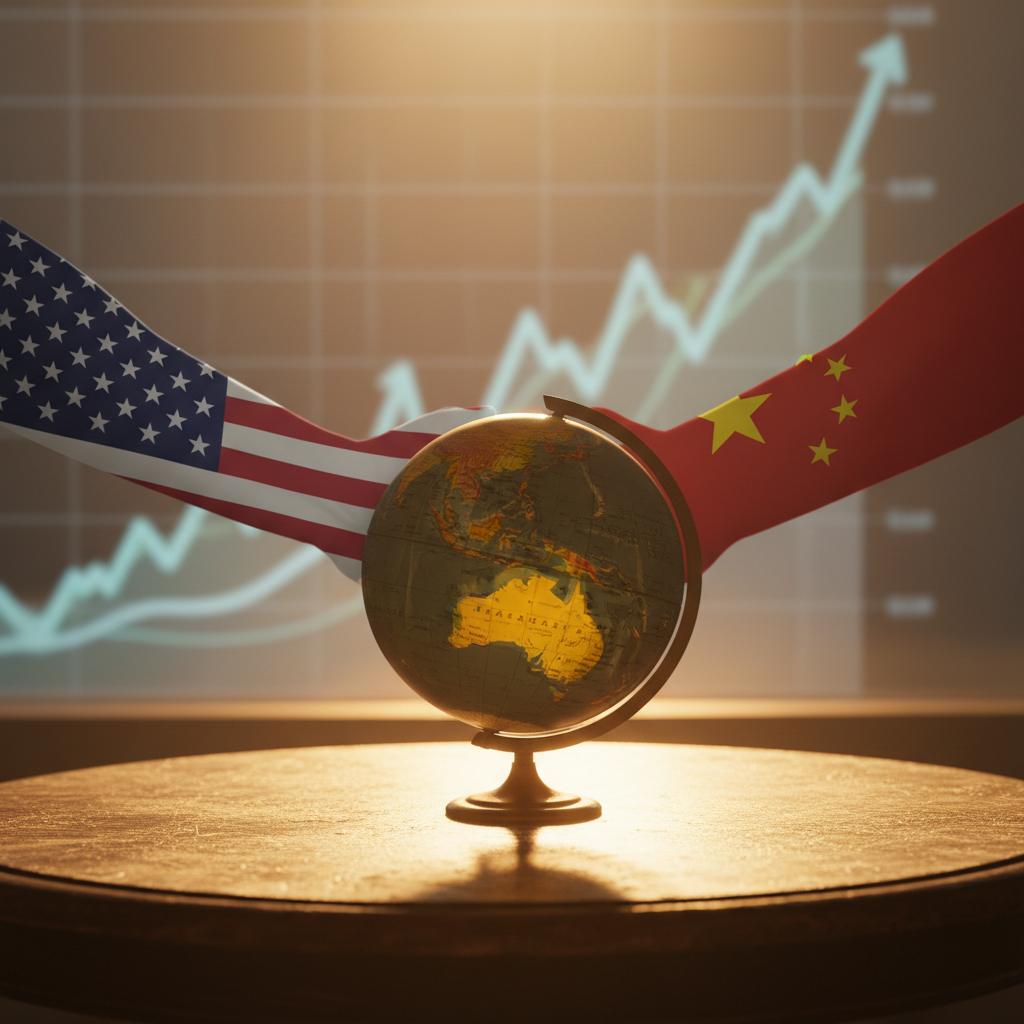
US-China Dialogue Eases: Global Economic Outlook and Australian Investment Opportunities

On May 14, 2026, the International Monetary Fund (IMF) issued a statement welcoming the initial positive dialogue between US President Trump and Chinese President Xi Jinping. This news was reported by Reuters and republished by AOL News (Source: AOL, May 14, 2026). At a time when the global economy faces numerous uncertainties, the easing of relations between the world's two largest economies undoubtedly injects a shot of confidence into the market, signalling potential new shifts in the global economic landscape.
Historical Context and Current Challenges
Looking back over the past few years, US-China relations have consistently impacted the global economic pulse. From trade friction to technological competition, the tensions between the two nations have repeatedly triggered market volatility, leading to disruptions in global supply chains and a decline in investment confidence. For instance, the trade war from 2018 to 2019 led to a significant drop in global trade volume, with some industries facing tariff barriers and rising production costs. At that time, many multinational corporations were forced to adjust their supply chain layouts, seeking "de-risking" strategies.
The IMF's positive statement comes as the global economy slowly recovers from the pandemic's impact, while simultaneously grappling with multiple challenges such as geopolitical conflicts, high inflation, and an energy crisis. As the world's two largest economies, the policy directions of the US and China have a pivotal influence on global trade, investment, and financial markets. The easing of dialogue, at least in the short term, is expected to reduce uncertainty and provide a more stable environment for global economic growth.
Impact on Global Trade and Supply Chains
The positive progress in US-China dialogue will most directly impact global trade and supply chains. For a long time, the US and China have been important trading partners. Improved relations could bring about the following changes:
- Potential Reduction of Trade Barriers: While a complete removal of existing trade tariffs in the short term is unlikely, the initiation of dialogue offers the possibility of gradual tariff reductions in the future. This would directly lower import and export costs for businesses in both countries, stimulating bilateral trade growth.
- Enhanced Supply Chain Resilience: In recent years, companies have sought supply chain diversification, and even relocated some production lines out of China, to mitigate geopolitical risks. Easing dialogue may prompt companies to re-evaluate their supply chain strategies, reducing the additional costs associated with excessive "de-risking." For example, cooperation in critical sectors such as semiconductors and rare earths may regain attention, helping to stabilise the global supply of high-tech products.
- Boost to Global Economic Growth: According to IMF forecasts, global economic growth is projected at 3.2% in 2026. If US-China trade relations continue to improve, this figure could be revised upwards. A more stable trade environment will foster investment and create jobs, thereby driving overall global economic growth.
Opportunities and Challenges for the Australian Economy
As a resource-rich nation highly dependent on international trade, Australia's economy is closely linked to US-China relations. The easing of US-China relations presents both opportunities and challenges for Australia.
- Stable Export Markets: China is Australia's largest trading partner, with immense demand for bulk commodities such as iron ore, coal, and agricultural products. Improved US-China relations mean a more stable external environment for China's economic growth, which will directly benefit Australia's exports to China. For example, in 2025, Australia's iron ore exports to China reached approximately A$120 billion, accounting for nearly one-third of its total exports. Stable demand forecasts will support commodity prices.
- Resurgence of Investment Confidence: Geopolitical tensions previously led some international investors to adopt a wait-and-see approach regarding long-term investments in Australia. The easing of US-China relations will boost global investor confidence, attracting more capital into the Australian market, particularly in traditional strong sectors like mining, energy, and education.
- Tourism and Education Recovery: China is a significant market for Australian tourism and international students. Easing relations will help normalise the flow of people between the two countries, further promoting the recovery of Australia's tourism and international education industries. Major cities like Sydney and Melbourne will be among the first to benefit.
However, Australia must also be wary of potential challenges. The dynamic balance of US-China relations may require Australia to employ a more refined balancing act in its diplomatic and economic policies to maximise its own interests.
Impact on the Australian Property and Construction Market
While seemingly macroeconomic, the positive developments in US-China dialogue will ultimately transmit their effects to Australia's local markets, including the property and construction sectors.
- Stable Construction Costs: A stable global supply chain implies that international prices for raw materials (such as steel, timber, and cement) are likely to stabilise. Australia's construction industry is highly dependent on imported materials; for example, some specialised steel and electronic components are sourced from Asia. If trade friction decreases, and transport costs and tariff risks are reduced, it will help stabilise Australian construction costs. This is crucial for ongoing infrastructure projects and residential developments in major cities like Sydney.
- Immigration and Population Growth: Global economic stability resulting from eased US-China relations typically promotes international talent mobility and immigration. As a popular immigration destination, Australia's population growth will further drive housing demand. According to the Australian Bureau of Statistics, Australia's population growth rate reached 1.6% in 2025, with most of this attributed to net overseas migration. Population growth is a fundamental driver of the long-term prosperity of the Australian property market.
- Increased Investment Demand: With improving economic prospects, overseas investors' interest in Australian property may rekindle. Particularly in prime cities like Sydney and Melbourne, high-quality residential and commercial properties will attract more international capital. This will not only stimulate new home construction but may also boost transactions in the established property market.
Future Outlook
Despite the IMF welcoming the US-China dialogue, we must recognise that improving relations between the two countries will be a long and complex process, potentially accompanied by setbacks. Several scenarios could unfold in the future:
- Optimistic Scenario: Dialogue continues to advance, gradually resolving key differences in trade and technology, further reducing global trade barriers, and stabilising supply chains. This would provide a significant boost to the global economy, with Australia's economy continuing to benefit, and the property market maintaining healthy growth.
- Neutral Scenario: Dialogue is maintained but progresses slowly, addressing only some low-hanging fruit, while deeper structural issues persist. The global economy remains as is, with limited uplift for Australia's economy, and the property market maintaining stable development.
- Pessimistic Scenario: Dialogue breaks down or falters, old frictions reignite, or new geopolitical conflicts emerge. The global economy faces renewed downward pressure, Australia's economy would be impacted, and the property market could face adjustments.
Conclusion
The easing of US-China dialogue undoubtedly sends a positive signal to the global economy and Australia. For Australian households and investors, monitoring macroeconomic trends, especially the trajectory of US-China relations, is crucial for making informed investment decisions. A stable and prosperous global economic environment will provide a solid foundation for Australia's property and construction industries. In this context, prefabricated construction, with its efficiency and cost-controllable characteristics, demonstrates unique advantages in responding to market changes and meeting housing demand.
(Source: AOL, May 14, 2026, report on IMF welcoming US-China dialogue)
Related Articles

EASOVA's Mission: Making Granny Flats the First Breakthrough in Australia's Housing Revolution
EASOVA's mission is not just to build granny flats, but to use them as a starting point to propel Australian housing into the next generation of upgrades. We believe that granny flats are the most suitable real-world scenario for first introducing fifth-generation housing concepts and smart systems. They can not only increase space and rental income but also become a vehicle for residential technology, integrating high-performance construction, age-friendly design, intelligent operation and maintenance, and continuous upgrade capabilities. To truly achieve this goal, we must integrate four core capabilities: structural design, customer decision-making, AI software and hardware, and financial support, to create a complete product system that is approvable, deliverable, and sustainably evolving.
22 Apr 2026
Australia's Rental Crisis Deepens: 70% Income on Rent, What's the Solution?
Australia's rental market is facing unprecedented pressure. Latest data reveals that some tenants are spending nearly 70% of their weekly income on rent, raising deep concerns about the cost of living and housing affordability. This article will delve into the causes, impacts, and potential solutions to this crisis.
14 May 2026
Honda Suspends Canada EV Plant: Global Manufacturing Challenges?
Japanese automotive giant Honda has indefinitely suspended its plans to build a multi-billion dollar electric vehicle factory in Canada. This event is not only a major tremor in the automotive industry but also reflects the complex challenges currently facing global manufacturing. This article delves into the underlying economic, geopolitical, and market factors.
14 May 2026