The Real Bottlenecks and the Eve of Explosion in Sydney's Prefab Granny Flat Market
For prefabricated backyard homes in Sydney, the real challenges are not factory manufacturing, but rather local design, site access, and on-site installation. Many projects fail not due to the product itself, but because they are stalled by the question of "can it fit through the side gate into the backyard."
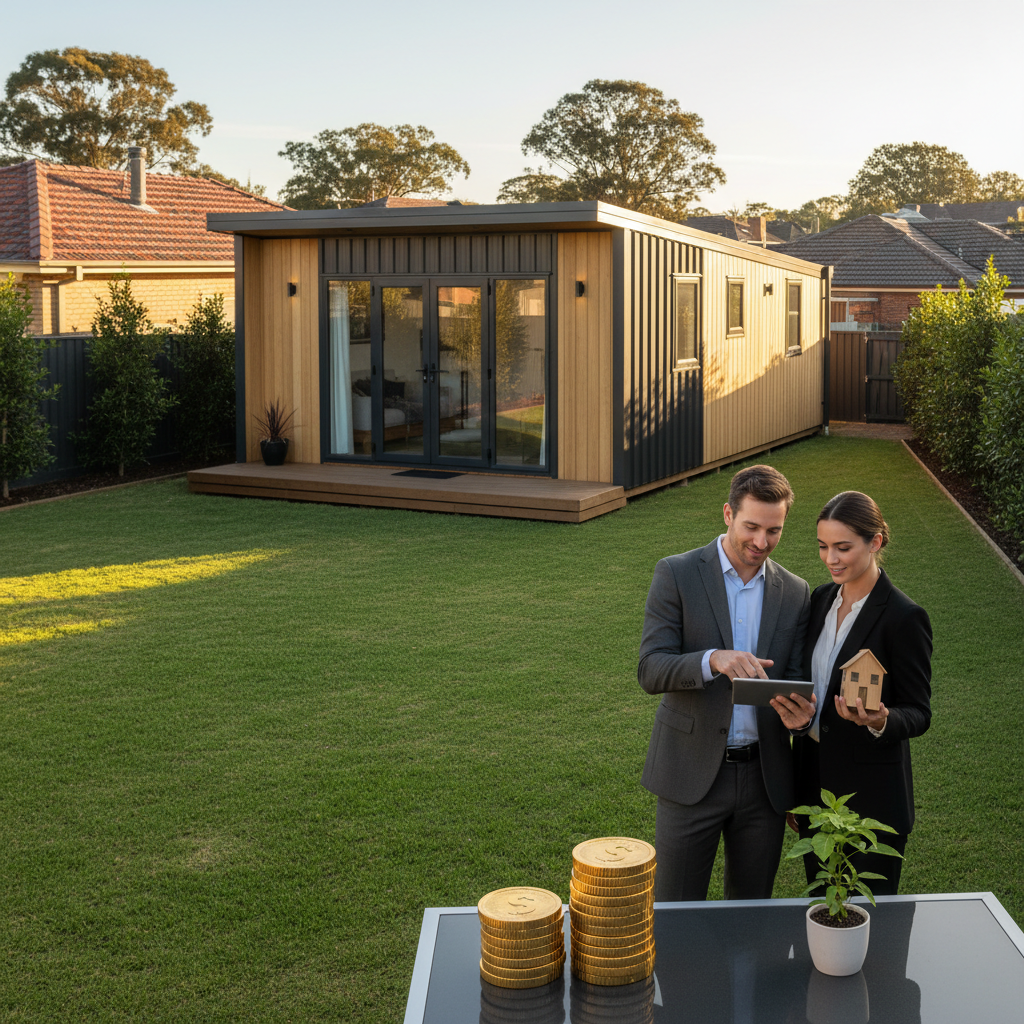
Over the past two years, Australia's prefabricated housing market has continued to heat up. Especially in Sydney, with housing shortages, high construction costs, ongoing scrutiny of approval efficiency, and the government continuously signaling policies to increase housing supply, prefab granny flats are gradually moving from a fringe concept to the center of a more realistic and actionable market discussion.
At the same time, a large number of manufacturing factories in China, due to domestic overcapacity, have begun to pivot towards prefabricated housing as a new direction for transformation, with Australia naturally becoming a key target market. On the surface, this appears to be a very logical industry match: China possesses mature manufacturing capabilities, a complete supply chain, and significant cost advantages, while Australia has long faced issues such as insufficient housing supply, long traditional construction cycles, high labor costs, and relatively low on-site construction efficiency. Theoretically, the two seem to be a natural fit.
However, upon truly entering this industry, one will discover that the core contradiction in Sydney's prefab granny flat market has never been about "whether a house can be built," but rather "whether the system that is built can truly be accepted, approved, signed off, constructed by the local Australian system, and ultimately achieve stable replication."
This is why, over the past two years, many prefabricated housing companies from China, despite seemingly mature products and competitive quotes, have struggled to genuinely penetrate the mainstream Australian market. The problem isn't just strict standards; it's that many factories misjudged their position within the Australian housing system from the outset.
Essentially, most overseas factories are not exporting a complete, ready-to-implement "house" to Australia, but rather a "component system" or "industrialized semi-finished product system" with manufacturing capabilities. In Australia, for this system to become a truly deliverable residential product, it must first undergo re-integration with local architectural design, structural design, construction logic, certification logic, and practical installation experience. In other words, what determines whether a project can be realized is never solely the factory's production capacity, but whether the local team is willing and capable of transforming it into an Australian product that can be signed off, constructed, and replicated.
Many overseas enterprises have been trying to find a shortcut: hoping to directly enter the Australian market with existing prototypes, modules, and production lines. However, the Australian housing system is not merely a manufacturing logic; it's a complete system of responsibility. Who designs it, who bears structural responsibility, who explains the connections, who is responsible for fire resistance, waterproofing, moisture resistance, wind resistance, connection methods, fixing details, and installation procedures, and who ensures the certifier is willing to sign off – none of these questions can be bypassed.
Therefore, the true first principle for prefab granny flats in Sydney is not to have a factory first, but to first have local systematic design capability.
For prefabricated housing to truly adapt to the Australian market, especially the practical scenarios of numerous independent house backyards in Sydney, systematic design must be led by an experienced local Australian team. This design is not about drawing a few renderings, nor is it simply "translating" mature overseas products. Instead, it requires a comprehensive chain-wide coordination from planning restrictions, approval logic, structural systems, material selection, joint details, construction paths, transportation limitations, on-site installation conditions, to certifier acceptance.
More importantly, a truly mature and suitable path for implementation often does not start by pursuing "large modules" or "whole-box" entry. Instead, it should begin with methods closer to local construction experience: first, breaking down the house into pieces, sections, and individual component systems that can be standardized for transport, moved manually or with small equipment, and efficiently installed. Over long-term construction practice, validate connections, installation methods, error control, and on-site adaptability, and then gradually evolve to higher levels of modular design.
This is because Sydney's granny flats differ significantly from large modular projects on open plots of land: they are not idealized "blank construction sites," but rather scenarios heavily constrained by real-world conditions. The construction conditions for many projects are extremely specific – narrow front yards, limited side access, sensitive neighborhood environments, restricted craning radii, controlled on-site entry times, trees, power lines, fences, original house positions, changes in ground level, and distances between existing buildings and boundaries can all directly determine whether an installation method is feasible.
In the past, the market was not short of scattered, similar attempts at prefabricated construction, but many projects ultimately got stuck not on the product itself, but on the construction site entry, especially the craning issue. Once a system relies too heavily on large lifting equipment, it immediately faces very real implementation barriers: not every plot is suitable for craning, and not every backyard has the conditions for large cranes to enter, lift, rotate, and operate safely. Many solutions work on paper, but once on site, it becomes clear that installation cannot be completed economically or efficiently.
Therefore, a prefabricated approach that is truly tailored to local conditions and suitable for Sydney's backyard market should not just pursue "the more complete it is in the factory, the better." Instead, it should return to the site itself: how can components enter through side gates, how can they be moved to the backyard through limited access, how can reliance on large cranes be minimized, how can rapid assembly be achieved without sacrificing construction efficiency, and how can installation accuracy, construction safety, and on-site operability be balanced? This is the true technical core of prefabrication for Sydney's granny flats, and the key to future scalable replication.
In other words, prefabrication does not equal "large modularization," let alone "whole-building transport." For Australia, especially the numerous backyard scenarios in Sydney, a more reasonable route is likely: based on systematic decomposition design, calibrated by local construction experience, bounded by lateral transport and backyard access as realistic constraints, ultimately forming a lightweight modular system that combines industrial efficiency with suitability for local land conditions.
This point is extremely important. Because those who truly succeed in the future will not be factories with merely the lowest manufacturing costs, but those teams that can integrate design, transport, installation, and approval into a single thought process. Whoever can solve the "last mile" from "drawing to backyard" will truly gain market entry.
From a market demand perspective, the opportunity for prefab granny flats in Sydney remains very clear. It's not just a story of "low-cost housing alternatives," but a real demand market formed around the reuse of existing land value, changes in family structure, increased rental income, and enhanced living flexibility. For many homeowners who already own land, adding an independent living unit in the backyard is essentially leveraging the second value of their land with relatively controllable construction costs in an era of high land prices. In contrast, while house and land packages in new development areas might also use prefabricated construction, their core contradictions remain high land prices, high development financing requirements, and long overall project cycles. In these projects, prefabrication primarily addresses traditional construction efficiency issues, rather than being the fundamental driver of market explosion.
This precisely illustrates that the true market space for prefab granny flats in Sydney is not about simply "who to sell houses to," but about "who can deliver a system that is truly certifiable, transportable, installable, financeable, and replicable to the market."
As the industry stands today, demand has become progressively clearer, and overseas supply chains are no longer the issue. What is truly lacking is that difficult-to-establish middle layer of capability: local systematic design capability, local standardized construction experience, sustainable and reusable connection and structural logic, and the ability to feedback this experience into product development.
Therefore, the biggest opportunity in Sydney's prefab granny flat industry now is not to continue debating whether prefab houses are good, but to quickly establish a product logic that truly aligns with Australian realities. This logic should not be built on "how a whole house is produced," but rather on "how this house passes through a side gate, enters the backyard, is quickly installed, and accepted by the certifier." Only by solving these most realistic problems first will modularization become more than just a concept and truly transform into a scalable market.
In this sense, the Sydney prefab granny flat market is indeed on the eve of an explosion. But this "eve of explosion" is not the eve of factory expansion, nor the eve of a promotional frenzy. It is the eve of the true maturation of local design systems, construction systems, and standardized product systems.
Whoever can achieve this step first in the future will not just be selling a granny flat; they will be proactively defining a new way of housing supply for Sydney's next phase.
Related Articles

Solving the Difficulty of Local Australian Banks Lending for Prefab/Modular Homes: The Core Lies in Breaking the Security Gap
Solving the difficulty of local Australian banks lending for Prefab/Modular Homes revolves around bridging the **“Security Gap”**. Because the main cost of prefab homes occurs at the factory stage rather than on the land site, traditional banks often refuse to issue progress payments as they cannot conduct on-site inspections and asset mortgages before the modules are installed on the land.
13 Apr 2026
Sydney Prefab Backyard Homes Market Research Report V2.0
Based on authoritative sources such as ABS trade data, NCC building codes, and HIA industry surveys, this analysis comprehensively examines the pre-fabricated granny flat market on the cusp of explosion and its breakthrough paths from eight dimensions: supply-side (AUD $278.5 million import value from Chinese factory capacity), demand-side (262,000 housing shortfall), regulatory-side (WaterMark/CodeMark/NATA certification barriers), design blind spots (wind loads/7-star energy efficiency), and the practical constraints of backyard construction in Sydney.
7 Apr 2026
Iran Conflict's Shadow: Global Economy & Australian Households Face Challenges
On April 24, 2026, Under30CEO reported that the conflict in Iran could trigger global economic instability, driving up prices and slowing growth. This article delves into the impact of Middle Eastern geopolitics on global oil prices, inflation, and supply chains, and explores the potential repercussions for the Australian economy and ordinary households.
25 Apr 2026