One Nation, Two Sets of Rules: The "Ice and Fire" of Granny Flat Accessibility Design in Victoria and NSW
Australia's granny flat construction is undergoing a quiet split – in Victoria, a door must be wide enough for a wheelchair; 100 kilometers away in New South Wales, the same door can be narrow enough for only one person to squeeze through sideways.
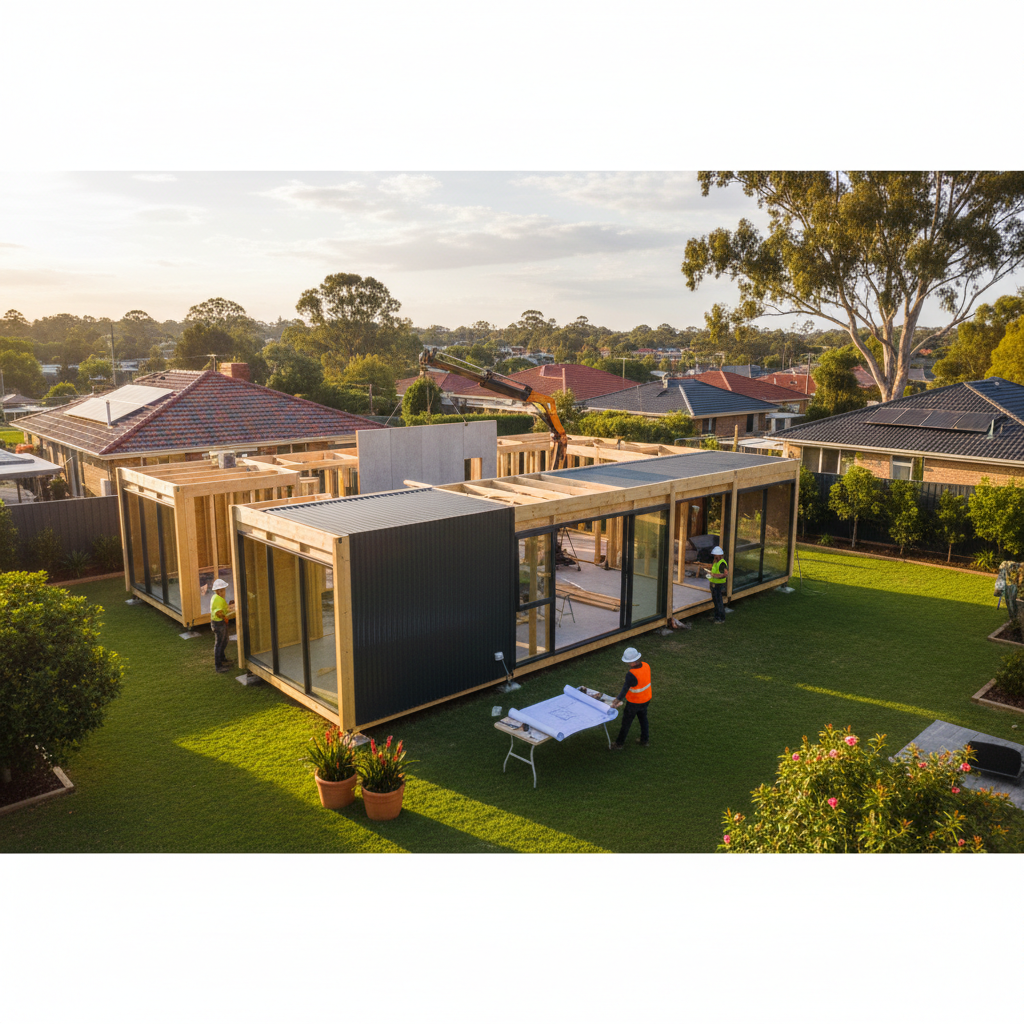
On May 1, 2024, Victoria officially implemented a far-reaching new building regulation: all new residential constructions – including the increasingly popular granny flats – must comply with the "Livable Housing Design Standard" in the NCC 2022 National Construction Code. This includes six mandatory requirements: step-free entry, wider doorways and corridors, accessible bathrooms, hob-less showers, and wall reinforcement for future grab rail installation.
Meanwhile, just across the Hume Highway, on the same page of the New South Wales building code for the same clause, there is only one cold line of English:
"This Part has deliberately been left blank."
This is not a system error, nor is it a legislative delay. It is a clear policy decision made by the NSW government – to reject all clauses regarding residential accessibility design in NCC 2022.
The Width of a Door, The Attitudes of Two States How big is the difference? Let's break it down item by item.
In Victoria, if you are building a 60-square-meter granny flat, from the very first day of drawing plans, you must answer these questions:
- Is there a step-free path at least 1.2 meters wide with a gradient not exceeding 1:14 from the backyard gate to the entrance door?
- Does the clear opening of the entrance door reach 820 mm – a full fist wider than the traditional 760 mm standard door?
- Are interior corridors at least 1 meter wide?
- Is there a bathroom on the ground floor with a clear space of 900×1200 mm in front of the toilet? Is there at least one hob-less shower?
- Are 12 mm thick structural plywood sheets embedded in the walls next to the toilet and shower, so that grab rails can be safely installed if needed in the future?
In NSW, the answer to every one of the above questions is the same: Not required.
The door can be the standard 760 mm width. Corridors can be only 600 mm. Showers can have a 15 cm high hob. No reinforcement material needs to be embedded in the walls. Building certifiers will not find these items on their checklist, because in the NSW version of the code, they simply do not exist from the outset.
Who is Pushing, Who is Resisting? In August 2022, federal, state, and territory building ministers agreed at a meeting to incorporate livable housing design into the National Construction Code NCC 2022. This standard is adapted from the silver level design guidelines published by Livable Housing Australia. The core idea is not to require every house to become a hospital ward, but to make small provisions during the construction phase – a slightly wider door, a flatter floor, an extra board embedded in the wall – so that the house can be affordably adapted in the future for seniors or people with mobility impairments.
Victoria, Queensland, Tasmania, ACT, and the Northern Territory have successively adopted this standard. South Australia will follow in October 2024.
But New South Wales and Western Australia have explicitly said "no."
The response from then-NSW Minister Kevin Anderson has been widely cited in the industry, with his core stance being: The NSW government does not support the mandatory implementation of minimum accessibility standards for detached dwellings at this stage, believing it would increase construction costs and be inappropriate during a housing affordability crisis.
This decision disappointed accessibility advocacy groups. The Council on the Ageing (COTA) and multiple disability rights organizations publicly criticized this position, pointing out that the cost of incorporating accessibility features during the construction phase is far lower than the cost of future renovations, and that over 1.1 million Victorians with mobility impairments, and even more NSW residents, will lose the opportunity to "age in place" in their own homes as a result.
Cost Controversy: How Much More Does It Really Cost? Cost is the core reason for NSW's rejection and the most controversial figure in this debate.
In actual construction in Victoria, the additional costs brought by the livable housing standard for a granny flat roughly include: upgrading door frames from 760 mm to 920 mm (approximately $50–100 AUD extra per set); increasing corridor width by about 20 mm of framing material (almost negligible); embedding a 12 mm plywood sheet in bathroom walls (material cost less than $50 AUD); meticulous waterproofing for hob-less showers (adding approximately $500–$1,500 AUD in waterproofing labor costs); and constructing an entrance ramp or platform (ranging from $500–$5,000 AUD depending on terrain).
Overall, industry estimates suggest that this standard adds approximately $2,000 to $8,000 AUD in direct construction costs to a granny flat. If designers "bake in" these dimensions into standard plans from the initial design phase, rather than modifying traditional plans, the incremental cost can be kept even lower.
In contrast, if an already built dwelling needs to be renovated for accessibility in the future – tearing down walls to widen doorways, removing shower hobs and redoing waterproofing, installing grab rail backing on wall surfaces – the renovation cost typically ranges from $15,000 to $50,000 AUD.
This is precisely the argument repeatedly emphasized by Victoria and the Commonwealth when promoting this standard: spending a few thousand dollars on provisions during the construction phase can avoid spending tens of thousands of dollars on renovations in the future. For Australia, with its rapidly aging population, this is not just a building issue, but a public health economics issue.
Granny Flat Market: One Product Line, Two Sets of Rules This policy divergence has had a direct commercial impact on the booming granny flat industry.
As Victoria and NSW have successively relaxed planning approval requirements for granny flats (Victoria no longer requires planning permits in most cases, and NSW can approve via the CDC fast track in as little as 10 business days), granny flats are moving from a "grey area" to mainstream residential products. Both states have a 60-square-meter size limit, and the target customers highly overlap – providing nearby living space for elderly parents, independent starting homes for adult children, or stable rental income as investment properties.
However, for prefabricated builders serving both markets, two sets of rules mean a tricky product strategy decision:
Should they unify all product designs according to Victorian standards, allowing NSW customers to also enjoy accessibility features (as a selling point rather than a burden), but bear slightly higher base costs? Or maintain two sets of design drawings and production parameters, offering lower quotes in the NSW market by using narrower doors and more compact layouts?
Some leading prefabricated builders have already made their choice. Some companies told us they choose to produce their entire line according to Victorian standards because "the management cost of maintaining two product lines far exceeds the material cost difference caused by a 60 mm wider door frame," and "age-friendly design" also commands a premium among the aging customer base in NSW.
Unresolved Questions NSW's rejection is not irreversible. The NCC is updated every three years, and discussions for the next version, NCC 2025, are already underway. Pressure from the federal level for states to adopt livable housing clauses has never disappeared, and the aging population issue will only become more urgent over time.
In 2023, the Australian Royal Commission into Violence, Abuse, Neglect and Exploitation of People with Disability released its final report, which specifically called for all states and territories to adopt the livable housing clauses in the NCC. This report provides strong policy grounds for the federal government to push for unified national implementation in the future.
Meanwhile, NSW's own demographic data tells an unavoidable story: by 2050, NSW's population aged 65 and over is projected to grow from approximately 1.7 million currently to over 2.8 million. The vast majority of these individuals wish to age in their own homes, rather than move into aged care facilities. If their home doors are too narrow, thresholds too high, and walls cannot accommodate grab rails, "aging in place" will remain an empty policy slogan.
Editor's Note A Melbourne architect once described Victoria's new regulations this way: "We are not building homes for today's residents; we are building them for who they will be in 30 years. A 60 mm difference in door width means nothing when you are 30; on the day you are 80, just had knee surgery, and are returning home with a walker, it's the difference between being able to get back into your own home or not."
This statement also applies to every granny flat in Sydney, Newcastle, and Wollongong. It's just that there, this 60 mm difference is currently not on anyone's checklist.
Data sources for this article: NCC 2022 (ABCB), Victorian Building Authority Practice Note LH-01, NSW Planning Portal BASIX Standards, Jensen Hughes industry report, Cooee Architecture Victorian granny flat guide. This article does not constitute legal or architectural professional advice.
Related Articles
Victoria Granny Flat (Small Second Home) 7-Star Energy Efficiency and Livable Design Research Report (A Must-Read for Chinese Manufacturers)
From May 1, 2024, Victoria officially enforced the NCC 2022 energy efficiency and livable housing provisions. All new Class 1a dwellings—including detached houses, townhouses, and granny flats (small second homes)—must simultaneously meet two new mandatory requirements: the 7-Star energy efficiency standard and the Livable Housing Design Standard.
24 Apr 2026
Sydney's Backyard Homes: New Housing Engine Under 2025-2026 Australian Tax Reforms
Facing changes in Australian tax policy and growing housing demand, Sydney granny flats are emerging as a highly attractive solution. This article will delve into their investment potential, approval advantages, and how to quickly realise your granny flat dream.
7 Apr 2026Sydney Granny Flat Construction: A Complete Guide
Considering building a granny flat in Sydney? This article will provide a detailed breakdown of every step, from initial planning and the approval process (especially NSW CDC) to budget considerations and final occupancy, helping you effortlessly achieve your investment or living dreams. Learn how to leverage prefabricated technology to accelerate project timelines.
6 Apr 2026